Posts

Showing posts with the label Tree Dwelling Birds

Eastern Whipbird

Image
Having mostly-green plumage and living in the dense undergrowth, the Eastern Whipbird is seen far less often than it is heard. Its whip-crack call is a characteristic of many of the moist forests in eastern Australia. The unusual feature of this call is that it is often performed by two birds calling in unison, with one bird contributing the first part of the call and another giving the second part. This so-called ‘antiphonal’ calling involved great co-ordination between the two birds to give the call its familiar whip-crack sound. Adult Eastern Whipbirds are mostly dark olive-green above, with a long tail, and a grey-white belly. The head and breast are black, with a broad white patch on the side of the face and a black crest. The eye is pale cream and the bill is black. Young whip birds are generally duller, with a smaller crest. The white cheek patch is absent in very young birds, and increases in size as the birds mature. Distribution The range of the Eastern Whipbird is ...

Apostlebird

Image
The Apostlebird is a medium-sized dark grey bird with a short strong bill, brown wings and black tail. It is normally seen in groups of six to ten birds, and is usually seen on the ground. It belongs to the group of birds known as 'mud-nesters', the Family Corcoracidae, noted for their communal life style and their bowl nests constructed of mud and plant fibres. Distribution: The Apostlebird is found in eastern Australia in inland areas from lower Cape York Peninsula, Queensland to northern Victoria and from Naracoorte to Mount Lofty Ranges, South Australia. There is also an isolated population in the Elliott and Katherine areas, Northern Territory. Feeding: The Apostlebird usually eats seeds and vegetable matter, insects and other invertebrates and, sometimes, small vertebrates. In autumn and winter, it will move to more open country, where seeds become the more important part of its diet. The Apostlebird forages on the ground in groups, often in association with...

Owl - Southern Boobook Owl

Image
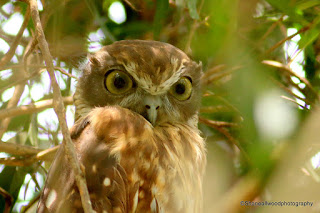
The Southern Boobook is the smallest and most common owl in Australia. It is identified by its plumage, which is dark chocolate-brown above and rufous-brown below, heavily streaked and spotted with white. The bill is grey with a darker tip, and the feet are grey or yellow. The facial disc is chocolate brown and the eyes are large and yellowish. Tasmanian birds are smaller and more heavily spotted with white, while birds of the Cape York rainforests are slightly larger and darker. Young Southern Boobooks are almost entirely buff-white below, with conspicuous dark brown facial discs. Like other owl species, the Southern Boobook is nocturnal. Birds are often observed perched on an open branch or tree-top. It is also known as the 'Mopoke'. Distribution: Southern Boobooks are found throughout mainland Australia and Tasmania, and on some coastal islands. Closely related species are found in New Zealand, New Guinea and Indonesia. Feeding: The Southern Boobook feeds...